Saturday, March 16, 2013

Isle find my Bali Ha'i

An azure ocean is a must for an island paradise (Porto Da Cruz, Madeira) 

‘Wonder how I'd feel, living on a hillside/Looking on an ocean, beautiful and still,’ American nurse Nellie Forbush wondered out loud in the film, South Pacific.

Well, it was a musical so she actually sang them, but as the long-term implications of her romance with wealthy French plantation owner, Emile de Becque, hit home, there was something she needed to know. Could she make a small pacific island her home?

South Pacific ignited my passion for islands
I was six or seven and living in a dirty, industrial south Wales town (this was in the days when Llanwern actually made steel) when I first saw the film, a hopeless romantic even at that tender age. South Pacific, with its island setting (and vivid colour filters), had an immediate impact on me. I was captivated by the idea of living on a tropical island, where the ocean stretched out as far as you could see, everyday life was relaxed, where you were surrounded by palm trees, vibrant flowers and bananas and the preferred mode of travel was boat.

In the film, the mystical ‘foggy’ island of Bali Ha'i loomed on the horizon, luring the unsuspecting to its shores and changing them forever.

‘Bali Ha'i will whisper, in the wind of the sea:“Here am I, your special island! Come to me, come to me!"'

Unreal it might have been, but I pinpoint my life-long obsession with islands to that very first viewing of South Pacific with the wonderful Mitzi Gaynor (amazingly not first choice for the part) stomping around singing about washing men out of her hair and being a cockeyed optimist.

'Real' islands have lots of banana plantations
Unfortunately, islands didn’t feature largely in my childhood, well not unless you count Barry Island (of Gavin and Stacey fame), the destination of choice for our annual street outings. With its gaudy boardings, noisy funfair and pots of tea on the beach, Barry didn’t quite fit into my idea of what an island should be.

Then, when I was nearly 20, something amazing happened. My sister, Gail, went to work at Smugglers Ride, a guest house on the Isles of Scilly. Within weeks she was loving island living and writing letters home in which she raved about her new home. Then, out of the blue, she phoned me. There was a job going, they needed another chambermaid at the Atlantic Hotel. Was I interested?

Was I…? I handed in my notice as a cashier/clerk at Harris Queensway and was on the helicopter to St Mary’s within days. Like Gail before me, I fell in love with the Scillies and the simplicity of a life where everything – work, leisure, shops, and friends – was within walking distance and nowhere was more than a stone’s throw from a turquoise ocean.

Gai and I enjoying the white sands of St Martin's, Isles of Scilly in the 1980s 
It was while on Scilly that I first became acquainted with Rachel Lyman Field’s poem ‘If Once You Have Slept On An  Island’.

My favourite stanza warns, ‘You may bustle about in street and shop/You may sit at home and sew/But you’ll see blue water and wheeling gulls/Wherever your feet may go.’

Enjoying an ice-cold dip on the Scillies 
Needless to say I adored Scilly and spent two happy summers there working first at the Atlantic and then, in 1983, as a silver-service waitress at Tregarthen’s Hotel.  There was only one downside. Though considerably milder than the mainland, the Scillies were still in the UK and although they boasted the amazing tropical Abbey Garden on Tresco, they still got their fair share of cold, blustery weather, grey skies and drizzle, even in the summer months.

The years passed and still I dreamed of my island paradise.

On the shelves of the Carnegie library on Corporation Road, I found a copy of We Bought An Island by Evelyn Atkins and marvelled that anyone could actually own their own island, albeit the tiny Looe Island in Cornwall.

I was filled with even more envy when I read Lucy Irving’s Castaway (which was later made into a film starring the late Oliver Reed). A few years later, and with her children in tow, Lucy followed up with another South Pacific adventure and wrote about it in her even more enjoyable sequel, Faraway.

The problem was that travelling to islands on the other side of the world took time and money – as a working mother of three I had neither. 

Over the years, I returned to Scilly for several holidays and even flew to the Greek island of Cephalonia (famous for being the location for the film, Captain Corelli’s Mandolin), but my heart still yearned for my very own Bali Ha'i (the actual location is the Hawaiian Island of Kauai).

Madeira: as idyllic an island setting as the mythical Bali Ha'i
And then, in 2007, Harri’s parents suggested Madeira for our first foreign holiday together. My first instinct was to dismiss it as a destination for ageing retirees, people who usually arrived by cruise ship and enjoyed afternoon tea at the exclusive Reid’s Palace. The toboggan ride at Monte was probably the nearest thing to excitement that Madeira had to offer. I can’t even remember what made me agree to go – something to do with Tenerife package holidays being very expensive over the Christmas period and mainland Europe being too cold.

Essential for island living - a waterfall to bathe in
How wrong I was about Madeira’s appeal! On that very first holiday, as we strolled high above the banana plantations on a rather vertiginous levada path and looked down at the glittering azure ocean, I turned to Harri and announced rather dramatically that I thought I’d finally found my tropical island.

We’ve just returned from our fifth holiday on Madeira and its appeal hasn’t dulled one iota – for either of us.

Madeira may not be situated in the South Pacific, but the memorable lyrics of Oscar Hammerstein II could equally have been written about our magical, real-life Bali Ha'i. 

More on Madeira in future posts.

A Madeiran sunset - the perfect end to a perfect day

Friday, March 15, 2013

Struggling to adapt


It's not always easy to adapt to new surroundings, however beautiful
Why, after all these years, do I still find packing for holidays so difficult? What to take, what to leave behind, how many undies, posh frock or casuals for nights out, heels? The list goes on.

When we’re off on our UK jaunts, I generally tend to err on the side of caution; in other words, I pack the lot. In suitcases, plastic crates, carrier bags and rucksacks, it all goes in.

But this time we were flying to Madeira, which meant a strict weight limit and, that most inconvenient of regulations, no liquids in containers of over 100ml in the cabin (ruling out shampoo, shaving gel, sun cream, etc).

When we booked back in October, Harri and I had decided we could easily survive with just one suitcase, that 20kg of luggage between us would be ample for an eleven day holiday, which would involve running one half marathon, hiking most days, dining out… Now said suitcase was lying open on the bed, my half was looking decidedly small. I began to panic.

Take it slowly, I told myself. Slowly and methodically, then you won’t leave anything vital behind.

When it comes to packing for overseas holidays, I try to split items into three categories:
  • completely frivolous or far too heavy
  • might be useful but can survive without 
  • must not forget under any circumstances.
Inevitably, there are some things, my heated rollers for instance, which potentially fall into two categories. Ordinarily, I can’t live without them, but as they weigh roughly the same as a small child and I was supposed to be ‘packing light’ (possibly the worst two words in the vocabulary), taking them was a non-starter. 

Anyway, I’ve promised Harri that I’ll   try out backpacking this year – yes, proper, ‘two pairs of smalls and a sleeping bag’ backpacking – so this holiday seemed like a good opportunity to practice straight hair.

I could do this, I told myself. I could set off on holiday with half a suitcase of clothing plus hand luggage. I started flinging things back into the drawer with gusto.


Relaxing with a glass of Coral and our new adapter
It was only 24 hours later, when we were unpacking in the Sao Paulo and Alegria Hotelthat the full extent of what I’d left behind hit me. Where was our Portuguese phrase book? The cheap Ikea sun cream?  My eye shadow? 

But far worse, from a practical point of view, was the missing electrical adapter. If there’s one thing that falls into the ‘can’t live without when abroad’ category, this is it. We needed it to charge our mobile phones, dry my hair (we were self-catering for five days) and charge our camera batteries (more on that later). I actually remember getting it out and putting it on the bed but for whatever reason it hadn't made the final 20kg.

This was serious – as serious as the time I left my daughters’ new coats behind on a camping trip to north Wales (I had no choice but to buy more), though perhaps not of quite the same magnitude as one of Harri’s childhood experiences. His father, Garrod, forgot to pack the tent poles on a family holiday to Cornwall. Realising his mistake, he packed the family – wife and three boys – back into the car and drove home to Cwmbran to get them. I think I’d have settled for buying a new tent, but then petrol wasn’t so extortionate back in the 1980s.

Well, we weren’t about to re-board a plane to the UK so we'd just have to buy another. Harri reasoned that the large supermarket just down the street was bound to sell them. We searched the aisles hopefully and came out empty-handed.

The cliff top walk from Camara de Lobos 
Harri came up with Plan B. We were doing a walk for Walking World the following day (Saturday) from Camara de Lobos back to Funchal along the newly opened promenade. The walk would take us past Funchal’s main hotel region, where, he reasoned, there were bound to be lots of shops selling the ‘can’t live without’ items at inflated prices.

We trawled round all three floors of Forum Madeira, Funchal’s answer to Cribb’s Causeway (though thankfully on a much smaller scale). It was all fashion, sportswear and cafes. No electrical shops and no adapters.

Finally, in despair, I persuaded Harri to do the one thing that men resist at all costs. You know, the thing that involves (ssshhh!) asking someone. Suddenly our luck changed.

The man sitting behind his computer in the small mobile phone/wifi shop was English. Not only that, he had a spare adapter at home. Best of all, his apartment was just metres away.

Man at C&A is still alive and kicking at Forum Madeira
I’m not religious but very occasionally you get the feeling there’s an omnipotent force watching over you and this was one such time (another was finding a 1917 edition of Raymond, Or Life and Death in a box of tatty old books I was sorting through at Raven House Trust).

Our new friend was indeed true to his word and wouldn't accept anything for the adapter.

So our holiday was saved by the kindness of a stranger. I’m thinking of flying with British Airways from now on though – for a higher fare price, each passenger gets a generous 23kg luggage allowance.

And that battery charger that we did remember to pack... someone (mentioning no names) managed to leave it behind in Madeira. Which only goes to prove that packing properly is essential at both ends. 

Sometimes it's easier just to sleep your way through problems


Wednesday, March 13, 2013

Birds of a feather

Low tide at Rhossili with Worm's Head in the distance

So Rhossili has been awarded third place in a list of best European beaches.

In a survey of worldwide tourists by TripAdvisor the windswept Welsh beach, popular with families and dog walkers alike, was beaten only by Rabbit Beach at Lampedusa, Sicily, and Playa de las Catedrales in Ribadeo, Galicia, Spain.

In the unlikely event that any reader hasn’t visited Rhossili, this magnificent three-mile stretch of sand lies on the tip of the Gower peninsula.

Thousands visit Rhossili annually to stroll along the beach, surf its waves and splash around in the sea.  As a tourist destination, Rhossili offers everything: miles of white sand, (at low tide) several shipwrecks, a public house, cafes, a National Trust shop, toilets, two small tidal islands and, most important, a large car park.

Two miles to the north, and tucked just behind Burry Holms, lies an equally beguiling stretch of sand but here the similarity ends. 

Whiteford Sands is largely ignored by the crowds
Unlike its buzzing, tourist-friendly, cash-grabbing neighbour, Whiteford Sands has no amenities and requires a ten minute walk from the nearest car park at Llanmadoc. 

Wild ponies graze the mud flats near Whiteford Sands

Our preferred route around Whiteford Point takes a good deal longer but passes some of the Gower’s most contrasting scenery and provides plenty of photographic opportunities, e.g. wild ponies grazing on the mud flats.


Now Rhossili has been crowned one of the top European beaches it’s likely to encourage even greater numbers to explore its attractions, leaving the peace and tranquility of Whiteford Sands to the locals and ‘those in the know’.

It’s the same story in the Brecon Beacons. The National Park's own website claims it is visited annually by ‘some 3.8 million people who spend around 4.2 million days there’.

So are the mountains thronging with hikers, trekking in convoy over the ridges?  The mere thought makes me chuckle.

Last spring and summer, Harri and I completed over 20 walks for inclusion in Harri’s forthcoming book on the Brecon Beacons for Vertebrate Publishing

Most days we saw hardly saw anyone at all, except when we ventured into villages and towns. Occasionally, we might pass a couple of hikers, or even more rarely, a small group of walkers, but more often we had great expanses of Welsh mountain all to ourselves. 

The truth is that the only places in the Brecon Beacons where you can reasonably expect to encounter large groups of walkers are on the well-walked trails leading to the twin peaks of Pen y Fan and Corn Du and in the popular waterfalls area at YstradfellteHike anywhere else in the Brecon Beacons and it’s quite possible, and very probable on drizzly, grey days, that you’ll not pass another person all day. 

That’s right. No-one. Anywhere. There are more sheep than people in this part of Wales. 

I recall watching a television programme several years ago which rated the ‘must-see’ places in the world. No prizes for guessing which large American gorge came top of the list. Tourist after tourist gushed over the Grand Canyon – almost to a person describing it as ‘awesome’ – though few had done much more than gaze across the mile-wide chasm before turning their attention to the man-made attractions which line the cliff top.

Bryce Canyon, Utah with not a cafe or shop in sight
A few months later, we were there ourselves, having first visited the rather more accessible and equally stunning (if far less frequently raved about) Zion and Bryce Canyons in Southern Utah.

‘There’s only so much red rock you can look at,’ Alanna pronounced, at eight clearly unimpressed by this geological monster of nature.

Flicking through an old guidebook recently, I read that almost all visitors to the Grand Canyon visit the South Rim (the hotels, cafes, gift shops, 3D cinemas, etc, are located here) where they spend just 40 minutes of their two-three hour visit looking at the canyon. North Rim is apparently just too far off the beaten track for the majority.

It’s exactly the same story in Madeira, where coach loads of tourists flock to Monte for the toboggan run or to Rabaรงal for the waterfalls. Not that either of these places isn't beautiful and well worth seeing, of course, but so is the magnificent and largely deserted high plateau of the Paul do Serra. 

St Ives: the most visited resort in Cornwall
In Cornwall, the big draw is St Ives, where on a rainy day in August, we were hard-pushed to find standing room in a pub. 

In Pembrokeshire, it's St David's that attracts the madding crowds (Harri will never forgive me for having to queue twice in a heaving beer garden for two halves of cider because, as I maintain, ladies don't drink pints!). 

Everyone, it seems, flocks to the same places for no reason other than these are the places that people flock. In our hundreds, we swarm into the pubs, cafes and gift shops that spring up in response to demand, though in some instances the natural landscape is so inaccessible, the commercial landscape now appears to be the main attraction, e.g. Cheddar Gorge, Tintagel. 

It often makes me wonder if humans really are birds of a feather… or just sheep?

 Birds... or just sheep? 

Sunday, February 3, 2013

Starter for ten

The snow-covered cliff tops above Marros Sands
There’s nothing quite as exciting as starting a new project, be it a script, a diet or a walking book.


Last week, against a bleak and snowy backdrop, we started our on-the-ground research for Harri’s latest commission: a top 10 walks guidebook to complement his official Wales Coast Path book (Amroth to Swansea Marina)

The top 10 format has already proved a great success for its publisher, Northern Eye Books.

These beautifully designed little books cost just £4.99 and provide clear directions, Ordnance Survey maps, eye-grabbing panoramic photographs and interpretation of points of interest along the way.

Until recently only walks in the Lake District, Peak District and the Yorkshire Dales
were covered, however the good news is that publishers Carl Rogers and Tony Bowerman have decided to roll out the format to include circular walks along the Wales Coast Path. It’s a great idea and will hopefully encourage many more people to explore Wales’ beautiful coastline and nearby countryside.

Still on solid ground - the steps above Pendine 
First to be published in the Wales series was fellow Outdoor Writers Guild member Sioned Bannister’s offering on Cardigan Bay North (available direct from Northern Eye).  

Sioned is the OWG social media expert and she has written a great little book, which I know Harri and I are going to find extremely useful on future holidays. (And in the mean time, we can just enjoy looking at those gorgeous panoramic photographs.)

The snow had all but disappeared when we left Newport but, as we travelled along the M4 corridor, we could see it was a different picture further inland. We later learned that snow had caused widespread disruption in Carmarthenshire the previous day.

‘Do you think snow settles on sand?’ I pondered and, for once, my personal sage could not provide the answer.

There's nothing to beat sun, sea... and snow
There was an empty car park at Pendine and almost nobody about, but we duly paid our £3 parking charge and pulled on extra layers.

My heart sank when Harri headed past the seafront cafรฉ and towards the steps leading to the cliff top. Now perhaps it would be wise to check in advance what’s expected of me on any given walk, but strangely I always forget to ask pertinent questions like ‘where are we going?’ and Harri sensibly omits to mention words like ‘steep’ ‘mud-bath’ or ‘arduous’ in his pre-walk briefings.

The uphill section was actually fine. There was no ice underfoot and the view across the snow-covered Pendine Sands was spectacular. We trudged across the cliff top in crisp, clean snow, relishing the crunching underfoot and the snow-laden gorse bushes.

It was only when we began to descend to Morfa Bychan beach that things started to become a bit hairy. Mud, it would seem, doesn’t always dry out underneath snow but, when the temperature isn't low enough, lies there oozing and squelchy, ready to send the unsuspecting hiker sliding down the mountainside on their backside. I tiptoed along, envisioning my fate, concerned about doing more damage to an already dodgy right foot, begging Harri to turn back.

Of course, we didn’t because Harri has a book to write and we must walk every inch of every walk – even those which are ultimately rejected. Instead, we headed straight up the opposite cliff, towards Marros Sands

One of Carmarthenshire's churned up fields,
 temporarily covered by snow
I’ve written about this section of the Wales Coast Path several times already so I’m not going to repeat myself. Suffice to say, it’s not pleasant when conditions are wet… and, once again, they were.

A short distance inland and the walking conditions immediately improved, lifting my spirits.

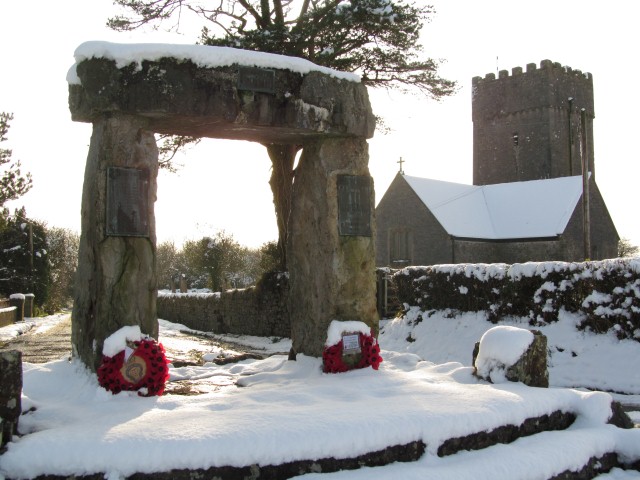
The village of Marros boasts a camping site, a church and an unusual war memorial, modelled on nearby Neolithic tombs. We lunched briefly on the stone benches in the church porch, but it was too cold to linger and we were soon on our way again.

The final stretch of the walk was stunning scenery-wise, however I struggled to get warm again. As we descended into a wooden valley, we came across a stunning log cabin, presumably a holiday let in the warmer months.

The Marros war memorial and church
At low tide, it’s possible to walk from Marros Sands to Pendine along the beach but the timing wasn’t right for us so we walked up an old cobbled path and emerged at the top of Pendine.

The day was closing in, but it seemed too early to head to our functional Travelodge room, so we decided to warm ourselves in Spring Well public house. For anyone who doesn’t know it, the Spring Well is the sort of pub every village/small town should have –  friendly if slightly eccentric locals willing to entertain passing strangers, a heavenly log-burning fire, ginger wine, but best of all, its very own kitler.

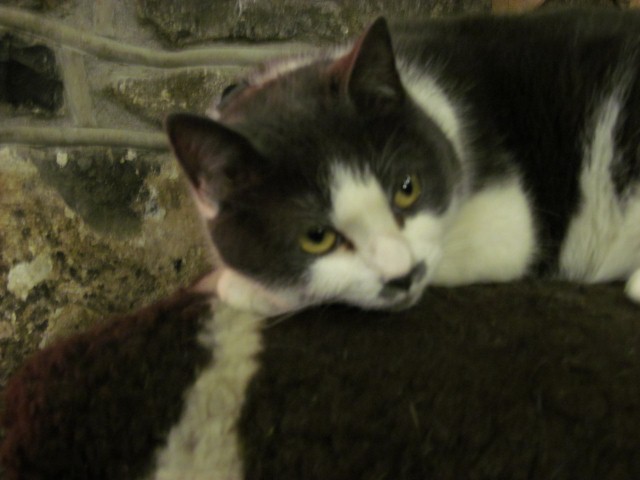
This walk may or may not make the final ten but seeing Stella the cat twitching her little grey moustache made the day's cold and muddy conditions worthwhile.

Stella has no idea why she attracts so much attention

(S)now you see them, (s)now you don't


Rhiwderin and the scene that greeted us from our bedroom window
What is it about fresh snowfall that persuades otherwise sedentary souls to brave the great outdoors and take to the streets in their boots and bobble hats?

The recent snow hit Rhiwderin overnight and we looked out on Friday morning to see our little village transformed into a winter wonderland of white rooftops and eerie quiet.  

‘Twas well into rush hour, but the scene was bizarre, not a vehicle was stirring, not even a car.

People walking alongside the River Ebbw
Despite the Tory rhetoric, there are some definite advantages to not being involved in gainful employment; one of them is removing the need to risk life and limb to reach an empty office ten miles away and spend the day emailing people who have made equally hair-raising journeys to their own place of work. Little actual work gets done, people arrive late and leave early, hoping to avoid a gruelling drive home in life-threatening conditions (but when your line manager refuses to embrace home-working, what alternative is there?).

In the UK – and despite considerable technological advances – a few centimetres of snow is still capable of changing everyday life beyond recognition. Roads close or become hazardous, supermarket shoppers act like it’s Christmas and most schools close, on health and safety grounds, at the first snowflake. And back to panic buying, why it is always milk and bread? Why not pasta and ready curries? That’s what most of us eat.

Me impersonating Marge in Fargo
However, the most noticeable change in snowy weather is the way it brings people out of their houses, gets families walking to the shops together, encourages teenagers out of bed, boosts the sense of community that modern life frequently lacks.

As per the norm when snow strikes, our car wasn’t going anywhere so Harri had to resign himself to a few days off work without pay (a new council policy).

All was not lost, however, as I persuaded him to venture outdoors for our first ‘non-professional’ walk of 2013. We’d barely left the house when we were talking to some young men pulling a sledge.

Bassaleg Road where, for once, people outnumber cars
Bassaleg Road wasn’t looking itself at all. Where was the constant stream of traffic, the convoy of articulated lorries taking a short-cut to and from the M4, the buses? 

We pushed ahead, amazed by the number of people everywhere. Laurel Drive – usually a pedestrian-free zone – had transformed itself into a busy thoroughfare as families trekked to the local store for those extra supplies of bread and milk. Fathers pulled sleighs loaded with their offspring, elderly people shuffled along, supported by relatives.  

It was the same in the side streets. Kids jostling for their turn on the toboggan, parents were shovelling snow off drives, snowmen being built, noisy snowball fights going on...

Everywhere I looked, people were walking and talking to one another.

Has Laurel Drive ever been this busy?
For a moment, I thought I’d been transported back to the 1970s, to a time when the entangled lives and concern for their neighbours portrayed by Coronation Street characters accurately reflected real life for those of us living in terraced housing.

All this good-natured camaraderie, this overt show of public spirit, it couldn’t last, could it? Sadly, not.

Within days, we’d all had enough. Heavy traffic once again dominated main roads, the lorry convoys were back and the human population retreated en masse to the security and privacy of our castles.

Roll on the next bout of snow… 

Junction 28's lovely old sign looks better still in the snow

Sunday, January 27, 2013

When is a national trail not a National Trail?


The Pembrokeshire Coast Path - one of Wales's three National Trails

The Ramblers is urging everyone who enjoys hiking to sign a petition to save England’s thirteen National Trails.

The walkers’ organisation is afraid Government plans to radically alter the way National Trails are managed will lead to historic trails like the Pennine Way and Hadrian’s Wall Path becoming ‘little more than overgrown mud-tracks’.

One of Wales's very own 'mud tracks'
National Trails in England and Wales are currently maintained by two national bodies: Natural England and the Countryside Council for Wales.

The Government wants to hand over management of National Trails in England to what they call Local Trail Partnerships. In other words, they want individual local councils to form ‘partnerships’ with other interested bodies which will then assume responsibility for the management and maintenance of National Trails.

The Ramblers is quite rightly concerned that already overstretched councils will struggle to maintain hundreds of miles of footpaths and trails.

At the moment, the proposals only affect England and there are no similar plans in Wales; however, you don’t need a crystal ball to speculate about what’s likely to happen to our National Trails if the Government gets its way because this haphazard ‘local’ management style is already being applied to the Wales Coast Path.

Confusingly, the much-lauded 870-mile continual trail around Wales is not currently a National Trail despite its high-profile launch and national branding. Take a look at the website and you’ll see listed 22 ‘path partners’ (all of whom are involved in some aspect of the path’s establishment, maintenance and promotion). No less than 16 of these partners are local authorities, each of which has its own (constantly changing) political agenda and increasing budgetary demands. No marks then for guessing that in the current economic climate many councillors will not view the maintenance of footpaths as a high priority (or vote winner).

A muddy stretch of the Wales Coast Path
above Laugharne
Partnership is one of the buzz words in the public sector. A former senior manager of mine once used the immortal words ‘if you’re doing it alone, you’re doing it wrong’. He has been (anonymously) quoted in many a high-level strategy ever since.

The trouble with partnerships is they need managing… and administering… and promoting. Meetings have to be organised, minutes and agendas distributed far and wide. Local government (in Wales at least) already ‘facilitates’ (another word much favoured by council officers) various partnerships, e.g. the Community Safety Partnership, the Health, Social Care and Well-being Partnership, and the Children and Young People’s Partnership.  There are probably others but I’ve been out of local government for over a year now so I no longer need to keep track.

I just don’t think local government needs any more partnerships! Moreover, different local authority areas have diverse priorities and some do not prioritise footpaths.
How many cows trekked the
Wales Coast Path  before us?

A few years ago, Harri and I walked the Pembrokeshire Coast Path – one of Wales’s three National Trails – over several weekends, starting at St Dogmael’s in July and finishing at Amroth the following January. 

As we crossed the Pembrokeshire–Carmarthenshire border, the previously well-maintained and well-surfaced coast path immediately degenerated into a mud-bath.

The sad truth is that despite all the publicity, the boasts of ‘year-round activities’ and ‘family fun’, Wales’s newest tourist attraction is almost unwalkable in places. The churned-up ground along some sections, e.g. the stretch above Marros Sands, suggests the passage of a herd of tap-dancing cows; hundreds of metres are passable only in the sturdiest of hiking boots.

Carmarthenshire’s disregard for its footpaths, even the scenic cliff-top trails comprising the Wales Coast Path, strengthens the argument for continued management of National Trails by a national body.

And, being realistic, local councils can’t be responsible for everything. Most already struggle to maintain the smaller, lesser-used footpaths and will often choose to close a footpath completely (or divert it along a busy road!) rather than invest in its maintenance.

Boardwalks - a 'site' for sore eyes
 (and wet feet)
Newport Council promotes 10 Countryside Walks and, as we’ve walked them all, I speak from experience when I say that most of them have sections which are impassable due to ‘invisible’ footpaths, brambles, inaccessible stiles, etc. I’d like to think someone actually walked them before producing the leaflets but I’m not so sure. Last summer, Harri contacted Newport council about an overgrown footpath and was told that it was impassable because no-one used it. Er, we were trying to use it!

It’s the same story with the Monmouthshire and Brecon Canal. The towpath from Malpas Road to Fourteen Locks is in an abysmal state; at the steepest point, it’s so muddy and slippery I’m surprised no-one has fallen into one of the locks. Carry on past the Visitor Centre towards Risca and into a new local authority area (Caerphilly) and suddenly the surface is flat and even and a delight to walk/run/cycle along.

I’m really proud that this little nation of three million people is the first in the world to have a continual path around its coastline. It’s pretty impressive, eh?

If Cameron’s Government pushes ahead with its proposals for National Trails, it’s possible that these magnificent historic walkways will gradually deteriorate to the standard of the path above Marros Sands or the ‘invisible’ paths promoted by Newport Council.


If you believe that National Trails are worth saving, please sign the Ramblers’ petition today and urge this Government to rethink its crazy proposals.


And just in case you were wondering, the other two National Trails in Wales are Offa’s Dyke Path (shared with England) and Glyndลตr’s Way.

National Trails deserve national and
not fragmented management