Showing posts with label Rhiwderin. Show all posts

Friday, April 19, 2013

Living in Rhiwderin

Tredegar Street - a vehicle free zone
Sadly, we can sometimes be in such haste to go off exploring new places that we don’t pause to appreciate the beauty on our own doorstep.

I spent most of my younger life lamenting the misfortune of being born in Newport, South Wales. I grew up in a Victorian terraced street on the east side of town, where I passionately loathed the steel industry and its accompanying grime, the concrete monstrosity of a town centre and the fast-flowing river which exposed banks of rich alluvial silt (or put bluntly, mud) at every low tide. Mostly, I hated Newport for what my younger self perceived as its complete lack of natural beauty.  


I could never shake off the feeling I’d drawn the short straw where my birthplace was concerned; a belief further compounded when, at twenty, I went to work in a hotel on the stunningly beautiful Isles of Scilly (and later mainland Cornwall). Returning from that first halcyon summer on St Mary’s, I travelled in the back of a taxi from Newport station to Corporation Road and sobbed such bitter tears the driver thought I’d come home for a funeral.

Home towns have a propensity for doing that… pulling you back time and time again, seemingly against your will. I’d lived somewhere else, somewhere pretty and clean. I was back, albeit temporarily on that occasion, and I detested Newport more than ever.

As I’ve grown older, the passionate loathing of my youth has developed into something of a love-hate relationship with Newport (which finally gained city status in 2002 after many years of trying). It’s lovely to live in the same locality as your family and long-time friends, to have a pretty good idea where everything is, to witness constant change but be able to remember how things used to be. And nowadays, of course, there’s the wonderfully sociable parkrun at Tredegar House to look forward to every Saturday.


The odd cow has grazed on this green 
In many ways, I’ve made my peace with Newport. Oh, it’ll never feature on one of those ‘most desirable places to live’ lists and I still hate the slimy mud on the riverbanks, but nowadays I’m not actively planning my escape.  The main reason for this massive change of heart is our move to Rhiwderin on the outskirts of the city, six years ago.

I often refer to the village as Newport’s ‘last outpost’ but that’s not strictly true because the 19 or so houses of Lower Machen, a mile farther along the A468, actually mark the very western edge of the city (confusingly, Machen itself lies within Caerphilly county borough but that’s bureaucracy for you).

The original Rhiwderin village was located directly opposite the level crossing, however newer developments – Springfield, Rhiwderin Heights and, most recently, Taylor Wimpey’s controversial Gerddi Rhiwderyn – have seen the village expand dramatically in all directions.

Our own little abode is located in the wonderfully quaint Tredegar Street, which, together with a few outlying farms and cottages, was pretty much the full extent of the village in the late 1800s. 

Our stone-fronted houses were built to house workers at the adjacent Garth Tinplate works (it closed about the time of the First World War and the site has long since been occupied by modern housing).


The Tabernacle Church was built in 1884
What makes Tredegar Street really unique is that the road is closed to vehicles.

And yes, you did read that right. Our street is probably the only terrace in Newport without bumper to bumper cars lining the kerb. Vehicular access is not completely banned but is limited to deliveries and the emergency services. The rest of the time, a heavy chain at the lower end of the street spans the distance between pavements and keeps it blissfully devoid of traffic.

It's quite normal to sit and watch the world go by in our street
The absence of cars means that residents and hikers generally walk up and down in the middle of the road. Stretches of pavement have been transformed into lawns and gardens; there are bird tables, potted plants and benches where locals sit on sunny days chatting and watching the world go by.

In the school holidays, children ride up and down on their bikes and play games in the street. It’s all wonderfully reminiscent of my own childhood in the 1960s before the rapid increase in car ownership put paid to enjoying terraced streets as playgrounds.

For such a small place, Rhiwderin has a lot going for it. For a start, it’s not a commuter village – deadly silent and deserted during office hours – but a living, breathing community full of friendly faces and boasting great facilities.


How many villages still have their own PO?
There’s the post office, run by Jackie, Howard and their son Rhys, which doubles as a corner shop and a very reasonably-priced off licence. 

Every Christmas Eve, Jackie throws a party in the shop where you can find locals drinking wine and munching sausage rolls between the toilet rolls.

Then there’s Rhiwderin Community Centre, which dates back to 1877 when it was built as the village school. Sadly, the school closed in 1986 but the building continues to play a central role in village life, hosting activities such as Women’s Institute meetings, indoor bowls, karate, a Meithrin playgroup and regular quiz nights.


The community centre was built as a school
A few metres away is Rhiwderin Village Hall, a single-storey prefabricated building which is used for regular craft fairs, dog training and guinea pig shows (no, I didn’t know people actually showed guinea pigs until we moved here!). The Tabernacle Church holds regular services, plus weekly slimming classes for the more weight-conscious members of the congregation.

We have a small children’s play area, a gurgling stream and a fair number of allotments, which were relocated two years ago after the original hundred-year-old site was sold to a housing developer. We have freshly painted white lines at our junctions and only a month ago, a rather nice new bus stop arrived in the village ‘square’!
Garfield is one of Rhiwderin's best known characters
If you fancy a beer, there’s a public house, the Rhiwderin Inn, in the village as well as several others, namely the Friendly Fox and the Ruperra Arms, just a short staggering distance away.

And of course there’s Garfield… the swaggering, ginger Tom who is everybody’s friend. Oh yes, it’s all here in Rhiwderin.

But what Harri and I enjoy most about living here is our proximity to the Welsh countryside.  

The 27-mile Sirhowy Valley Walk runs straight past our garden gate and when the urge to go hiking strikes, we can head towards the hills, wander along the river in the stunning Rhymney Valley or plan walking routes that involve passing our local castles.


Ruperra Castle was destroyed by fire
Ruperra Castle, now sadly dilapidated and out of bounds to visitors, was once home to one of the most powerful men in Wales. The impressive and immense medieval Caerphilly Castle occupies around 30 acres and is the second largest castle  in Britain. And for romantics, there is Castell Coch, a 19th century Gothic revival castle built on the remains of a genuine 13th century fortification.

Yes, there's plenty to keep the avid hiker happy in this part of the world.

Newport will never be my spiritual home. But if I avoid town centre and the River Usk and focus on the beauty around me, on the sheep grazing high above Rhiwderin and the wooded mountains and meandering footpaths beyond, it’s not so difficult to convince myself I’m living somewhere entirely different.

P.S. Rhiwderin is a Welsh place name which roughly translates as ‘bird hill’.

Update: The South Wales Argus (our local daily) featured Rhiwderin in a Now and Then feature.


It takes us five minutes to reach open countryside


Sunday, February 3, 2013

(S)now you see them, (s)now you don't


Rhiwderin and the scene that greeted us from our bedroom window
What is it about fresh snowfall that persuades otherwise sedentary souls to brave the great outdoors and take to the streets in their boots and bobble hats?

The recent snow hit Rhiwderin overnight and we looked out on Friday morning to see our little village transformed into a winter wonderland of white rooftops and eerie quiet.  

‘Twas well into rush hour, but the scene was bizarre, not a vehicle was stirring, not even a car.

People walking alongside the River Ebbw
Despite the Tory rhetoric, there are some definite advantages to not being involved in gainful employment; one of them is removing the need to risk life and limb to reach an empty office ten miles away and spend the day emailing people who have made equally hair-raising journeys to their own place of work. Little actual work gets done, people arrive late and leave early, hoping to avoid a gruelling drive home in life-threatening conditions (but when your line manager refuses to embrace home-working, what alternative is there?).

In the UK – and despite considerable technological advances – a few centimetres of snow is still capable of changing everyday life beyond recognition. Roads close or become hazardous, supermarket shoppers act like it’s Christmas and most schools close, on health and safety grounds, at the first snowflake. And back to panic buying, why it is always milk and bread? Why not pasta and ready curries? That’s what most of us eat.

Me impersonating Marge in Fargo
However, the most noticeable change in snowy weather is the way it brings people out of their houses, gets families walking to the shops together, encourages teenagers out of bed, boosts the sense of community that modern life frequently lacks.

As per the norm when snow strikes, our car wasn’t going anywhere so Harri had to resign himself to a few days off work without pay (a new council policy).

All was not lost, however, as I persuaded him to venture outdoors for our first ‘non-professional’ walk of 2013. We’d barely left the house when we were talking to some young men pulling a sledge.

Bassaleg Road where, for once, people outnumber cars
Bassaleg Road wasn’t looking itself at all. Where was the constant stream of traffic, the convoy of articulated lorries taking a short-cut to and from the M4, the buses? 

We pushed ahead, amazed by the number of people everywhere. Laurel Drive – usually a pedestrian-free zone – had transformed itself into a busy thoroughfare as families trekked to the local store for those extra supplies of bread and milk. Fathers pulled sleighs loaded with their offspring, elderly people shuffled along, supported by relatives.  

It was the same in the side streets. Kids jostling for their turn on the toboggan, parents were shovelling snow off drives, snowmen being built, noisy snowball fights going on...

Everywhere I looked, people were walking and talking to one another.

Has Laurel Drive ever been this busy?
For a moment, I thought I’d been transported back to the 1970s, to a time when the entangled lives and concern for their neighbours portrayed by Coronation Street characters accurately reflected real life for those of us living in terraced housing.

All this good-natured camaraderie, this overt show of public spirit, it couldn’t last, could it? Sadly, not.

Within days, we’d all had enough. Heavy traffic once again dominated main roads, the lorry convoys were back and the human population retreated en masse to the security and privacy of our castles.

Roll on the next bout of snow… 

Junction 28's lovely old sign looks better still in the snow

Wednesday, October 24, 2012

Something's getting sore on Route No 4

The original Route 4 through Tredegar Park 
All that blogging about (stolen) bikes must have been prophetic because two weeks ago our trusty X-reg Astra was handed the death sentence by the garage and, for the first time in eighteen months, I found myself back on the saddle.

I have to admit to being an intermittent cyclist. I tend to have mad bursts of enthusiasm, like the few weeks in spring 2010 when I decided it was a great idea to cycle to work regularly and duly pedaled all the way to Croesyceiliog (and back) several times a week. Then there was that awful journey home, the day of our big Queen’s High School reunion at Malpas Cricket Club, when the heavens emptied on me and my run-proof mascara ran and ran until I could barely see where I was going. By the time I reached Fourteen Locks I resembled a one-eyed Alice Cooper, squinting desperately and trying to avoid careering off the towpath and into the lock. The whole experience put me off cycling for quite some time, I can tell you.

On another occasion, Harri and I were cycling in the vicinity of Mynydd Machen and I needed to slow down before negotiating my bike through a rather narrow gap in a fence. Now I can do the nifty little manoevres; I can also (just about) click my way up and down the gears. I’m just not so adept at doing both things at the same time; one minute I was happily wobbling towards Harri, the next I was on the floor with a heavy mountain bike toppled on top of me.

The canal towpath is full of wildlife
There were good times, of course, like the time I realised that cycling uphill was infinitely easier in gear 1:1 and the numerous times I’ve free-wheeled down Laurel Drive; however, of late, my love affair with cycling has dwindled and had Harri not had his ‘brainwave’ (that we could cycle to Cwmbran to look for a new car before he started work in Caerleon at 10 am), I’d probably have left it that way.

But Amazon doesn’t yet sell used cars, so we had no alternative but to go searching. So, at ten past eight on the morning after I’d pounded the streets of Cardiff for 13.1 miles, abandoning gel soles, socks and a water bottle along the way, I found myself perched behind the handlebars of my mountain bike about to tackle another half marathon (and a bit), only this time on wheels.

The world goes by a lot more slowly on a bike – it took me nearly three hours to cycle to Cwmbran, look at two cars and cycle home alone via the longer (flatter) route – and once I’d re-acclimatised myself with the gears, I actually started enjoying meandering around Newport on two wheels.

A landmark which tells me I'm almost there(ish)
When you don’t have to concentrate on the road, predict (I think the proper word’s ‘anticipate’) the entirely unpredictable actions of the driver in front, behind, to the left and to the right, then you start to wake up to the world around you, tuning into the wildlife living in the city.

Like the family of swans preening their feathers on the edge of the canal –  mam and dad swan proudly fussing their four grown-up children; the moor hens darting around on their spindly little legs; the grey squirrels, so used to humans that they barely glanced up as I cycled past. When a rat scampered across the cycle path running alongside the River Usk, it was just another factor in a hugely enjoyable morning.

Despite the aching bottom, I decided that I liked cycling after all.

So much so that the following day I was off again, this time heading to Asda, Raven House Trust (where I am now an enthusiastic volunteer), Capel Court (to deliver Dad’s shopping) and finally, home. By now, my confidence was wheelie soaring (sorry!) and I ignored the well signposted Route 4, choosing instead to pedal through Tredegar Park and beyond. Interestingly, this was the route of the intended cycle path but agreement was never reached on the section through the former golf course.

The now very overgrown Tredegar Park Golf Course (yet more land owned by Newbridge Estates, the company which fought so hard to ruin Rhiwderin village and have now turned the century-old allotments into a monstrous housing estate) is familiar running territory for me, but the uneven terrain was tough on two wheels. After struggling across a stretch of muddy footpath, I headed enthusiastically towards an ornate bridge (it looked solid – and flat) and took a sharp left turn, bouncing down a muddy bank towards the Ebbw. It was only after I’d cycled a fair distance over bumpy ground that it dawned on me that I was on the wrong side of the river and the only way to reach Ford Lane would be to clamber up a ten feet wall with a bike on my shoulders or turn back.

It's tough going up, but even tougher bouncing down
You see, that’s the problem with cycling... take a wrong turning, misjudge a gear and you end up having to extricate a dead weight lump of metal out of a tricky situation... or risk falling off!

On the evening of the half marathon the only muscles that weren’t aching were my gluteals... now two long days on the saddle had ensured that my posterior was suffering as much as everything else.

And so... I abandoned the bike and started walking everywhere, which took even longer, especially when your walking companion is Harri and the marvellous Tredegar Arms pub is en route.

Friday, July 13, 2012

It's raining, weathermen


Unexpected puddles can be troublesome 

Meteorology has to be one of very few professions (along with politics) where you can get it wrong, week after week, month after month – yet still hang onto your job.

Harri, like all outdoor writers, spends an inordinate amount of time online checking the short and long-term weather forecast and, as a couple, we perhaps discuss the weather more than most.

At the very least, it’s helpful to know whether it’s opportune to fill the space in the bottom of my day pack with a lightweight kagould or our miniscule Past Times picnic rug. On a more serious note, we want to stay safe and well in the mountains and that means wearing suitable clothing for the weather conditions (which always poses more problems for me than for Harri!).

First, there are the shoes – do I wear heavy, ankle-high Karrimors or my favourite Brasher sandals (my first present from Harri)? Perhaps I should hedge my bets with Salamon cross-country shoes – or would my feet fare better in last year’s waterproof Teva Itundas?

With fleeces of every style, weight and fitting filling my wardrobe, deciding which one to wear on any particular trip presents another pre-hike dilemma. Chunky and warm could turn out to be a life-saver (quite literally) on a freezing mountain top but is cumbersome to carry if the sun puts in an unexpected appearance; the stylish, light-weight choice ties neatly around the waist but provides little protection in a gale force 7.

Leg attire is just as troublesome. Long trousers? Shorts? What about that pair of zip offs? Long johns worn under trousers equals cosy, but overheating could become an issue during a tough ascent. Warm socks, cool socks, running socks, no socks?  

Decisions, decisions. Every hiking trip throws me into a quandary, and it’s one made worse by the weathermen’s inability to forecast accurately more than an hour or two ahead.

For near ombrophobes like me (I hate the rain and avoid walking in it whenever possible), it’s important to have specific advance warning of a soaking, however the language used in weather forecasting is becoming as vague as the read-into-it-what-you-will wording preferred by astrologers.

Wikipedia describes meteorologists as being ‘best known for forecasting the weather’ (my italics) and with phrases like ‘likely to’ and ‘expected to’ peppered throughout the Met Office and BBC weather pages, it’s difficult to believe there’s any science at all behind the current predictions.

Clouds often behave in mysterious ways

With 2012 likely to go on record as the wettest summer since records began, I suppose meteorologists can be forgiven for offering a tiny glimpse of hope every few days – though as Nietzsche argued ‘in reality, hope is the worst of all evils because it prolongs man’s torments'’.

The relentless rain hasn’t spoilt all our fun – we did manage a 90-minute walk around Rhiwderin and Rogerstone this morning with just a light sprinkle of the wet stuff falling on us (me in  waterproof, Harri without) – but how much nicer it would be if we could roam the mountains in tee-shirts, shorts and sandals. It is summer, after all.

Saturday, June 23, 2012

Phantom footpaths

Harri battles his way across a Newport footpath
One of the best things about living in Newport’s prettiest outpost is being able to leave our garden and be in the countryside within minutes.

There are definitely some places well worth seeing in our immediate vicinity – the fire-damaged but still haunting Ruperra Castle, Craig Ruperra’s stunning 360 degree vistas, the beautiful Rhymney Valley and (Harri’s favourite) Mynydd Machen, to name a few.

Newport council is doing its best to promote the countryside around the city with its Let’s Walk Newport pack – ten walks ranging from 2.8 miles to 8.7 miles. To (mis)quote Naomi Campbell, Harri and I don’t generally get out of bed for anything under ten miles, but there’s a certain appeal to exploring the countryside on your doorstep.

Factor in high petrol costs and it makes perfect sense to hike local . . . until you try to find some of Newport’s footpaths. In theory, they exist – at least Let’s Walk Newport and our Ordnance Survey maps suggest so – but locating them on the ground is akin to searching for a needle in a haystack.

Blocked footpaths are the bane of a hiker’s life. In popular hiking areas, footpaths are walked sufficiently often to keep brambles, nettles and other plant life at manageable levels, but Newport, it seems, just isn’t particularly popular with outdoor types.

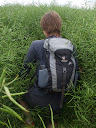
Last week, we really had to battle to stay upright in Pen-y-lan as we struggled through a huge field of overgrown rape. The plants weren’t just growing across the footpath, they’d been planted on the footpath. Accidental or what?

I'm a hiker, get me out of here!
We’ve had similar experiences trying to circumnavigate a restaurant/garage in the Bassaleg area (no prizes for guessing which one). The footpath has been legally diverted but the new route is so overgrown with nettles that it’s virtually impassible (quick tip: if you do get stung by nettles, do not, repeat DO NOT, scratch your skin – the pain rapidly diminishes if ignored).

We’re not unsympathetic to the plight of those who have inherited or bought up great swathes of Wales’ countryside, mountains and coastal areas, of course we’re not. We realise that they want their birthright or hard-won gains protected from the pitter-patter of hikers’ feet. We understand how having walkers peering over the wall into their palatial homes and landscaped gardens can be – well, perhaps a little unnerving at times. After all, what's the point of money if you can't buy yourself a bit of privacy, a sizeable slice of the countryside?

It’s just that, as law-abiding citizens, we like to see other people operating within the law too. Public footpaths, as depicted on maps, are part of the Queen’s highway, and if landowners don’t understand what that means, I’ll keep it simple. Hikers have a legal right to walk across a footpath on your land – you have a legal duty to ensure we can find them!

Don’t even start me on bulls. A future post, maybe.

Sunday, October 16, 2011

Don’t turn the spotlight off Wales

Fields in the Rhymney Valley


I groaned inwardly yesterday morning when I heard a Radio 4 presenter refer to rugby as Wales’ national religion. 

Wales so rarely gets a mention on UK radio that it was novel to find my countrymen the centre of attention for several minutes.  It was strangely unsettling, however, to have our national psyche analysed in such a public way and to learn that Welshness hinges on an obsession with an oval ball and the fifteen muscle-bound men who fight over it. 

Alas, we lost the semi-final to France so the Welsh squad is on its way home and this little country of three million people and several times more sheep will once again be forgotten as the spotlight turns back to England.

Okay, the Welsh team might not be playing in the Rugby World Cup final, but the Radio 4 team should know that Wales has an awful lot more going for it than rugby.

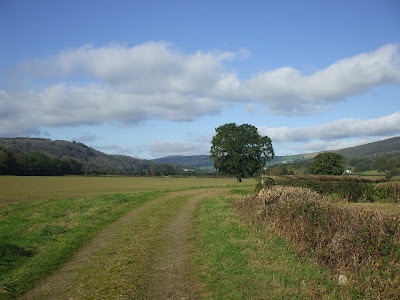
Top of the list is the stunning Welsh scenery and, for most people, it’s right there on our doorstep, ready to explore and enjoy without costing a penny.

Today, we decided to stick close to home and walk the lower slopes of Mynydd Machen and the Rhymney Valley.  Leaving my ruck sack behind (Harri carried drinks and a few nibbles), I galloped up the first grassy slope and was soon waxing lyrically about the beauty of the undulating fields surrounded by their forested hills.

It’s an area we walk regularly. We didn’t stick rigidly to Harri’s Walking World route, though we did manage to include his recommended stop at the Cefn Maby Arms.  Amazingly for mid October, it was still warm enough to sit outside with our drinks.  This is what hiking is really all about - you just can't beat a glass of beer or cider after a long, tiring walk.

The highlight of the route for me is always the magnificent Plas Machen farmhouse and the arable fields which surround it. 

Picture 1
The magnificent Plas Machen farmhouse (copyright Newland, Rennie Wilkins)
If I’d been a location scout for Hammer Horror Films back in the fifties and sixties, this is the place I’d have brought Christopher Lee and Peter Cushing for filming.  Even in bright sunshine, there’s something tantilisingly haunting and spooky about the house, which is currently on the market for an undisclosed amount.

Plas Machen was once home to one of the innumerable branches of the Morgan family. Following the renovation and extension of Tredegar House (which itself hosts the scariest Halloween event I’ve ever attended) in the Restoration Period, Plas Machen was abandoned by the family and become a tenanted farmhouse.

I have no idea what the future holds for this beautiful and historic house, but I desperately hope its new owner won’t destroy its faintly gothic facade and that Plas Machen will continue to enthrall (and slightly terrify) future generations of hikers.