Tuesday, August 21, 2012

On - and off - the buses


You might need a bank loan if you're planning
to leave Porthleven by bus
Now that I’m in training for the Cardiff half marathon, I’ve been forced to abandon some of my shorter lane and riverside runs, and focus my efforts on pounding the streets of Newport West.
   
This morning, as I puffed along the pavements of Bassaleg, Western Avenue, High Cross and Rogerstone, something occurred to me. Despite passing numerous bus stops on several different routes, not one of the people waiting at them looked under retirement age.

Despite its terrain, most of Madeira is
accessible by bus
Of course, this could be because I’d waited until after rush hour to set off (unlike my mate Merv, I’m pretty useless at ‘car dodging’), however it is the middle of the summer holidays and with flexi-time/shift working pretty much the norm now, there must be plenty of younger people catching buses after 9am – or is there?

I love travelling on public transport; in San Diego, Paris, Barcelona, Madeira, Rome – anywhere, in fact, where it’s abundant, cheap and reliable, anywhere other than the UK.

In Wales, public transport is universally lamentable and costly – unless you’re travelling to Cardiff. The imaginatively named coastal bus services in Pembrokeshire – the Poppit Rocket, Strumble Shuttle, Puffin Shuttle and Coastal and Celtic Cruisers – are also great value and run regularly throughout the summer season but, unfortunately, services like these are in the minority. 

Elsewhere, the buses that do run are increasingly sporadic and, worse, completely unaffordable to those on low incomes.

My daughter, a social worker in the Rhondda, sees firsthand how many families and young people are effectively trapped because they lack the means to travel from their deprived communities to look for work or educational opportunities. How unfair and illogical that the retired teacher or nurse enjoys free bus travel for a shopping trip to Cardiff or lunch ‘down the Bay’ when a young person desperately seeking employment can barely scrape together the bus fare for an interview.

Travelling by bus to Lisbon from Setubal was cheap and easy
Let me make it clear, I’m not ageist; after all, at 51 I’m not exactly a spring chicken myself. I also think it's commendable that the Welsh Government recognises the importance of getting out and about for individual well-being. No older person should be cut off from their family and friends, from leisure activities and shopping, simply because they don’t drive and can’t afford the bus fare.

I agree wholeheartedly with these lofty ‘aims’ (good public sector word there) but not with the wholly predictable knock-on effect, i.e. massively inflated bus fares for everyone else, whatever their financial situation.

I went to a school reunion a few weeks ago and decided to catch the last bus home. The fare cost £1.60 for a single journey of around four miles, not too bad as a one off but it soon mounts up if you do the journey regularly. A quick glance around the bus informed me I was the youngest passenger by a good decade making me the only paying customer.

Journeys between neighbouring towns demand increasingly crazy fares. When Harri and I walked the Torfaen Trail  a few years ago, the deteriorating weather almost persuaded us to abort our plans in Blaenavon. It was only the cost of the bus fare back to Pontypool that kept us going – two single fares for a five-mile journey would have cost us over £9. 

It was a similar story when we were doing the South West Coast Path in Cornwall. The bus driver on the Porthleven to Penzance route admitted that demanding the astronomical fares really embarrassed him. 

I’m convinced that bus fares have risen dramatically since free travel for over 60s was introduced. It’s only a theory but I’m guessing that now the majority of the bus-travelling population does so absolutely free of charge, bus companies are hiking their prices (Freudian slip there) for everyone else.

Tomorrow as we embark on the Amroth-Swansea section of the Wales Coast Path (Harri is writing the official guide for Northern Eye Books), there is no doubt that the escalating cost of bus fares will raise its ugly head again. We have two buses to catch to our starting point at Amroth (we then spend the day walking back to the car) so, over the next few weeks, I’m certain to utter those immortal words ‘how much?’ 

I’m a socialist; I have no desire to see older people struggling to make ends meet or to experience social isolation because they can’t afford bus fares.

I often wonder, however, if the Welsh Assembly could have better used the money spent on free bus passes for the over 60s to subsidise public transport for everyone. I really am struggling to think of even one over 60 who isn’t far better off than Harri and me!

Friday, July 13, 2012

It's raining, weathermen


Unexpected puddles can be troublesome 

Meteorology has to be one of very few professions (along with politics) where you can get it wrong, week after week, month after month – yet still hang onto your job.

Harri, like all outdoor writers, spends an inordinate amount of time online checking the short and long-term weather forecast and, as a couple, we perhaps discuss the weather more than most.

At the very least, it’s helpful to know whether it’s opportune to fill the space in the bottom of my day pack with a lightweight kagould or our miniscule Past Times picnic rug. On a more serious note, we want to stay safe and well in the mountains and that means wearing suitable clothing for the weather conditions (which always poses more problems for me than for Harri!).

First, there are the shoes – do I wear heavy, ankle-high Karrimors or my favourite Brasher sandals (my first present from Harri)? Perhaps I should hedge my bets with Salamon cross-country shoes – or would my feet fare better in last year’s waterproof Teva Itundas?

With fleeces of every style, weight and fitting filling my wardrobe, deciding which one to wear on any particular trip presents another pre-hike dilemma. Chunky and warm could turn out to be a life-saver (quite literally) on a freezing mountain top but is cumbersome to carry if the sun puts in an unexpected appearance; the stylish, light-weight choice ties neatly around the waist but provides little protection in a gale force 7.

Leg attire is just as troublesome. Long trousers? Shorts? What about that pair of zip offs? Long johns worn under trousers equals cosy, but overheating could become an issue during a tough ascent. Warm socks, cool socks, running socks, no socks?  

Decisions, decisions. Every hiking trip throws me into a quandary, and it’s one made worse by the weathermen’s inability to forecast accurately more than an hour or two ahead.

For near ombrophobes like me (I hate the rain and avoid walking in it whenever possible), it’s important to have specific advance warning of a soaking, however the language used in weather forecasting is becoming as vague as the read-into-it-what-you-will wording preferred by astrologers.

Wikipedia describes meteorologists as being ‘best known for forecasting the weather’ (my italics) and with phrases like ‘likely to’ and ‘expected to’ peppered throughout the Met Office and BBC weather pages, it’s difficult to believe there’s any science at all behind the current predictions.

Clouds often behave in mysterious ways

With 2012 likely to go on record as the wettest summer since records began, I suppose meteorologists can be forgiven for offering a tiny glimpse of hope every few days – though as Nietzsche argued ‘in reality, hope is the worst of all evils because it prolongs man’s torments'’.

The relentless rain hasn’t spoilt all our fun – we did manage a 90-minute walk around Rhiwderin and Rogerstone this morning with just a light sprinkle of the wet stuff falling on us (me in  waterproof, Harri without) – but how much nicer it would be if we could roam the mountains in tee-shirts, shorts and sandals. It is summer, after all.

Tuesday, June 26, 2012

Rope Bridges


The coastal rope bridge at Carrick-a-Rede, Antrim, Northern Ireland 
We writers like to think of ourselves as versatile, so when I heard about Caerleon Arts Festival’s comic poetry competition, I decided I should have a go.

My entry was very hush-hush (I know one of the judges) and – I thought – not a bad effort for someone who hasn’t attempted to write poetry of any kind since university.

Harri liked my poem very much, but wondered if it was maybe a little elitist, i.e. he thought that few, if any, on the panel of judges would understand the feeling of absolute exhaustion (mental as well as physical) when faced with yet another peak to climb. In essence, he doubted whether they would grasp the exciting concept of a system of rope bridges across Wales!

Alas, he was right - I wasn't even short-listed. I am, however, determined to publish my first-ever comic poem so, for all you hikers who wish there was some way to make the mountains a little easier, here it is:

Rope Bridges

If there’s one thing that hikers hate – yes, even more than stiles –It’s conquering the highest peak for miles and miles and miles

Then spotting just across the vale, another bloody cairnAnd knowing that the only route is down then up again.

But wait, I think there is a way to salve those weary feet A nifty little rope bridge ‘twixt where the high points meet.

Starting with the Beacons, Snowdonia, Pen y Fan,Rope bridges are Wales’ future – our all-inclusive plan.

The Rhinogs, Cambrian Mountains, Carneddau, Cadair Idris
Just sway your way from A to B and hike above the abyss.

You’ll need a head for heights it’s true; perhaps Glyndŵr’s nerve.When faced with sheep or goats, a bull, it’s wiser not to swerve.

The all-Wales coast path beckons, those heathered trails drop deepRope the gaps between the cliffs ‘cause tourists don’t do ‘steep’.

From Rhyl to Aberdovey, Mwnt to Pembroke DockTransform the landscape, add the ropes, keep hikers off the rock.

The plan solves unemployment. No job? Then plait a bridge.What skills are more transferable than linking ridge to ridge?

Think of it, one climb a day, the tough bits done and dusted.Yet a question still remains, can suspended ropes be trusted?

Brecon beacons cattle might appreciate a few rope bridges 


Saturday, June 23, 2012

Phantom footpaths

Harri battles his way across a Newport footpath
One of the best things about living in Newport’s prettiest outpost is being able to leave our garden and be in the countryside within minutes.

There are definitely some places well worth seeing in our immediate vicinity – the fire-damaged but still haunting Ruperra Castle, Craig Ruperra’s stunning 360 degree vistas, the beautiful Rhymney Valley and (Harri’s favourite) Mynydd Machen, to name a few.

Newport council is doing its best to promote the countryside around the city with its Let’s Walk Newport pack – ten walks ranging from 2.8 miles to 8.7 miles. To (mis)quote Naomi Campbell, Harri and I don’t generally get out of bed for anything under ten miles, but there’s a certain appeal to exploring the countryside on your doorstep.

Factor in high petrol costs and it makes perfect sense to hike local . . . until you try to find some of Newport’s footpaths. In theory, they exist – at least Let’s Walk Newport and our Ordnance Survey maps suggest so – but locating them on the ground is akin to searching for a needle in a haystack.

Blocked footpaths are the bane of a hiker’s life. In popular hiking areas, footpaths are walked sufficiently often to keep brambles, nettles and other plant life at manageable levels, but Newport, it seems, just isn’t particularly popular with outdoor types.

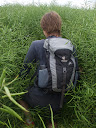
Last week, we really had to battle to stay upright in Pen-y-lan as we struggled through a huge field of overgrown rape. The plants weren’t just growing across the footpath, they’d been planted on the footpath. Accidental or what?

I'm a hiker, get me out of here!
We’ve had similar experiences trying to circumnavigate a restaurant/garage in the Bassaleg area (no prizes for guessing which one). The footpath has been legally diverted but the new route is so overgrown with nettles that it’s virtually impassible (quick tip: if you do get stung by nettles, do not, repeat DO NOT, scratch your skin – the pain rapidly diminishes if ignored).

We’re not unsympathetic to the plight of those who have inherited or bought up great swathes of Wales’ countryside, mountains and coastal areas, of course we’re not. We realise that they want their birthright or hard-won gains protected from the pitter-patter of hikers’ feet. We understand how having walkers peering over the wall into their palatial homes and landscaped gardens can be – well, perhaps a little unnerving at times. After all, what's the point of money if you can't buy yourself a bit of privacy, a sizeable slice of the countryside?

It’s just that, as law-abiding citizens, we like to see other people operating within the law too. Public footpaths, as depicted on maps, are part of the Queen’s highway, and if landowners don’t understand what that means, I’ll keep it simple. Hikers have a legal right to walk across a footpath on your land – you have a legal duty to ensure we can find them!

Don’t even start me on bulls. A future post, maybe.

Tuesday, June 5, 2012

RIP Tommy Jones


An obelisk marks the spot where Tommy Jones' body was found
After weeks of walking in the peaceful Black Mountains, the twin peaks of Pen y Fan and Corn Du on a Bank Holiday Monday came as a bit of a culture shock.

The Brecon Beacons National Park might span 519 square miles but yesterday there were only two summits that people wanted to conquer. 

The heavily eroded trails might have resembled school walking buses, but no amount of ‘traffic’ can diminish the magnificence of these mountains (the highest in South Wales).

Tommy was trying to reach Cwm-llych when he vanished
Our descent from Corn Du also gave me the opportunity to reflect once more on the tragic story of five-year-old Tommy Jones, who died on the ridge above Llyn Cwm-Ilwch (where a memorial stone now stands) after going missing on August 4th 1900.

The story has haunted me since I first heard it twenty years ago. My daughters were roughly Tommy’s age and I could barely bring myself to think about the terror that small boy must have felt, lost and alone in the blackness of the mountains.

A tragedy like the one that befell Tommy’s family would never happen today.

Tommy had been walking to Cwm-llych with his father but was allowed to run ahead with an older cousin; refusing to cross a stream, he tried unsuccessfully to retrace his steps alone.

A hundred years later, our risk-averse society means that few children are allowed to venture to the local park without supervision, let alone wander around in the countryside, or god forbid, up a mountain.

When I grew up, in the sixties and early seventies, the widely held view seemed to be that parents were there to guide their children but not to control their every move. As for entertaining us, a trip to the local cinema or swimming baths was as exciting as it got.

This meant that during the long summer holidays we children had to entertain ourselves – and without spending money (in our terraced street there wasn’t much around). We were lucky back then; there were pockets of wasteland that hadn’t been ‘developed’ where we could play and build dens, an adventure playground a short walk away at Somerton and exciting (if dangerous) playground equipment like the Witch’s Hat and the Cradle.

As we got older and willing to walk further afield for our entertainment, the long-closed Bulmore Lido became popular and if we experienced the call of the sea, there was our very own coast path a few miles away at Goldcliff. 

Goldcliff at low tide - Newport's own 'sandy' coast
Fishing in nearby reens was another favourite; in those days, they were all teeming with wildlife – tadpoles, minnows, elvers, ‘flatfish’, newts, pond skaters. No self-respecting child of the late sixties could fail to be fascinated with the life cycle of a frog.

We walked for hours with nothing to sustain us but the odd tiptop (bought for pennies in the ubiquitous local shop). I can’t recall our parents being particularly concerned if we disappeared for the whole day, which was just as well as we rarely had any idea where we were going.

This was rambling in the true sense – but without the maps, rucksacks, sandwiches or water bottles.

The odd calamity – my sister once lost a shoe between the boulders at Goldcliff and I’ve still got a scar on my thumb from slicing it open in the local reen – and one awful tragedy – a boy from our street was crushed by a paper bale – certainly didn’t deter us from pursuing future adventures.

Halcyon days, unfortunately unlikely to be experienced by the majority of today’s children.

Friday, May 25, 2012

A higher level of living


The distinct 'fingers' of the Black Mountains
In this current hot spell all I want to do is lose myself in our beautiful countryside (and with my map reading skills I’d probably do just that if Harri wasn’t around to issue me with frequent directions). Seriously though, there is nothing more uplifting for the human spirit than to trundle for miles along centuries-old tracks, footpaths and mountain trails, pausing only occasionally for a bite to eat or a dip in a cool stream.

On Wednesday we completed the ninth walk for Harri’s forthcoming book Day Walks in the Brecon Beacons (commissioned by Vertebrate Publishing) – at 16 miles, the loop from Llanbedr, crossing from one Black Mountain ‘finger’ to another, is the longest.

Harri studying boundary stones
It was a scorcher of a day, but the vast landscape – and the fact that Harri is currently reading Raymond Williams' People of the Black Mountains – got us thinking and talking about the last Ice Age. Although the line of rocks marking the upper edge of the glacier is clearly visible in many places, it’s difficult to picture the landscape as it would have looked then and almost impossible to imagine the day-to-day lives of our nomadic cave-dwelling ancestors further south.

When you are trekking across the peaks of Pen Cerrig Calch, Pen Allt Mawr and Pen y Gadair Fawr discussing massive historical geological events, our own insane, materialistic, overly-competitive and overly-complicated society feels not just thousands, but millions of years away.

Yesterday, Radio Four’s Ramblings programme featured Stuart Jessop who, with his dog Poppy, is walking around much of the coast of England as part of a campaign to reduce the stigma associated with mental illness.

Stuart has depression and he spoke eloquently and movingly about it. He describes walking as ‘a form of therapy’ and writes on his website ‘when I’m feeling low, a day spent out walking can lift my mood significantly’.

I didn’t catch the whole programme, but Stuart’s determination to manage his depression in such a positive way really impressed me and reminded me of an urban myth I once heard about a GP in Crickhowell who allegedly refused to prescribe his patients with medication for stress and anxiety but instead ‘prescribed’ a list of walks in the surrounding area. Only if the walks failed to lift the person's spirits, he told them, would he be prepared to consider medication. 

Feeling small on the top of Waun Fach
I’m not trying to downplay mental illness and the terrible impact it has on many people’s lives, but I do think Erich Fromm was onto something in the fifties when he wrote (in The Sane Society) that man’s removal of himself from nature has had a detrimental effect on his emotional health. Written half a decade later, there are definitely echoes of Fromm’s theory in Oliver James’ excellent Affluenza, which postulates that the dogged pursuit of status and material possessions, i.e. selfish capitalism, does not result in happiness, rather the opposite.

While I can't compete with Fromm and James, I do have a few crumbs of advice for anyone who is weary of the ideology that drives our growth-obsessed culture, or is sinking under the arbitrary bureaucracy of the typical working day – find a mountain and climb it!

Thursday, May 17, 2012

Live stock


I've gone off bacon sandwiches for good!

Two decades ago, as a breast-feeding mum, I watched a lamb tugging at a ewe’s underside as it tried to suckle and felt a sudden affinity with this other, slightly woollier, mother.

From that day, I stopped eating lamb completely except in situations when to refuse would offend, or worse, embarrass, my hosts.  I even went vegetarian for a few years until another pregnancy – and severe anaemia – sent me heading back to the meat counter.

After an abysmal April when our walking boots barely saw the light of day, we’ve been getting out and about again. And guess what – I’m getting all sentimental about baby animals to the point where Harri is forbidding me to take any more photographs of sheep, lambs or anything else with four legs.

Worse, I’m starting to consider vegetarianism all over again – yesterday’s evening meal was a delicious homemade butternut squash curry. 

You see, while it’s easy to divorce those hermatically sealed packs of raw flesh from live animals when you spend your days in town, it’s horribly difficult to cook bacon after you’ve spent a good ten minutes chatting to two friendly and oh-so-cute tail-wagging piglets on the escarpment above Llangattock.

Still fancy a beefburger?
And has anyone looked into the eyes of a young calf recently? Those big trusting eyes and eyelashes to die for – oops, wrong word but you get my drift. Somehow even the leanest fillet steak loses its appeal when you start joining the dots and working out what happened between number 1 and number 20.

Thankfully, I’ve never eaten mutton – I mean, how could anyone look at those dozy animals and think ‘haute cuisine’? 

Go into a field full of sheep and the entire flock does one of two things – runs away from you in terror or runs towards you in anticipation. 

One of the braver lambs
It’s impossible to predict their reaction from day to day. My theory is that it’s linked to what we’re wearing. Yesterday’s pink fleece was clearly sheep language for ‘we're here to feed you’ because we were quickly surrounded by up to a hundred sheep, while last week’s mass exodus was down to the subliminal message sent out by my navy fleece (‘we're here to eat you’).

I admit I’m a bit sheep obsessed. I must have taken at least thirty sheep photographs yesterday – most now consigned to the rubbish bin it’s true – but sheep are entertaining in so many ways. For a start, ewes are hapless mothers who seem incapable of keeping their young charges in the same field, let alone under mama’s watchful eye. There’s a tragic inevitability to what happens when we climb over a stile into a field of ewes and their lambs on a recognised footpath. One sheep spots us and baas loudly to warn her own offspring of oncoming danger (navy fleece warning). Within seconds, there are lambs running around in all directions, each one beating desperately like the kid in the Rolf Harris song ‘I lost my mammy’ . Meanwhile, another ewe emits a few gentle baas but doesn’t look unduly worried that in his blind panic, junior has managed to get his head stuck in a fence.

Oh, the joys of spring hiking. Where’s that tofu?